
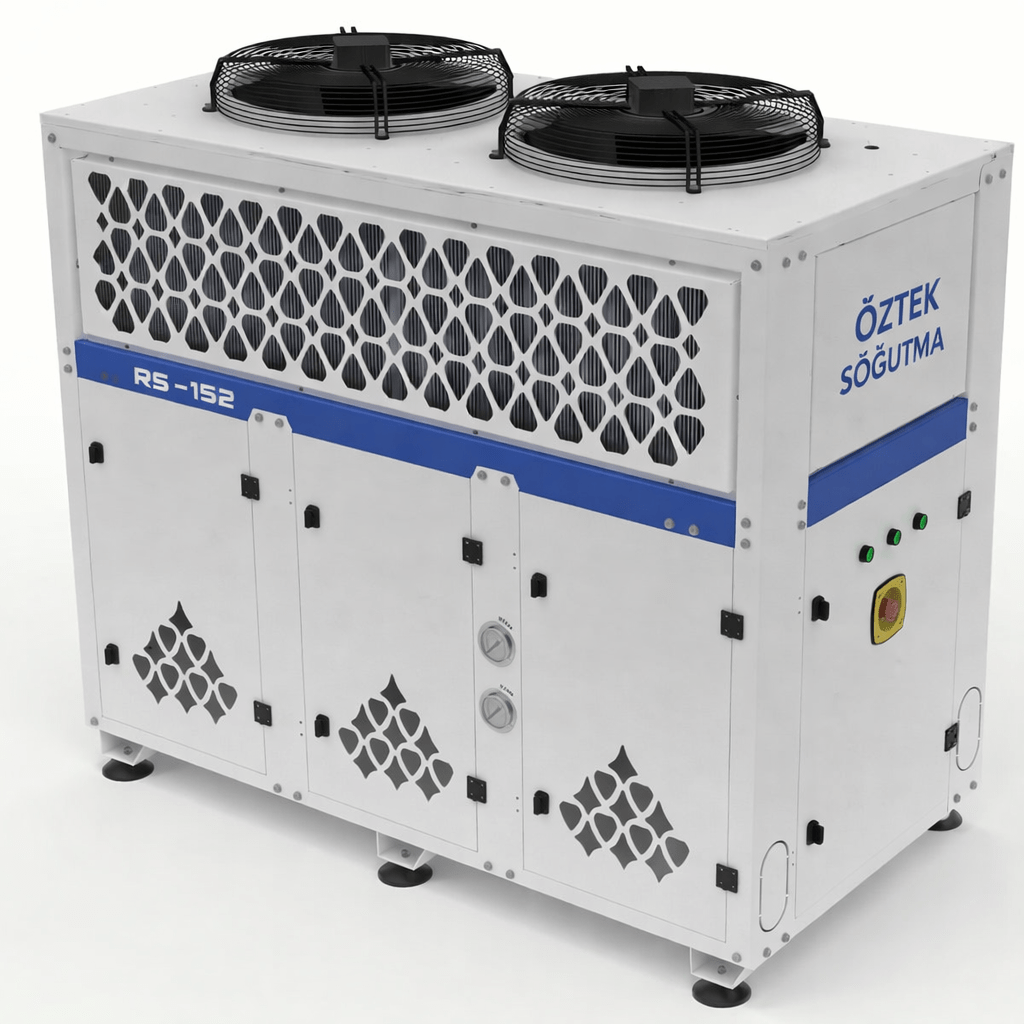
Hydrogen heats up quickly as it is compressed. In hydrogen compressors, refuelling stations and tube filling lines this heat must be removed safely and continuously. Intercoolers between compressor stages, aftercoolers and pre-cooling heat exchangers before dispensing all depend on a cooling circuit fed by a chiller or a dry cooler.
Where does heat come from in hydrogen compressors?
- Heat of compression: In diaphragm, piston or ionic compressors gas temperature rises at every stage; without an intercooler the next stage runs inefficiently.
- Compressor body and oil: The body jacket, diaphragm head and oil circuit need cooling water.
- Aftercooler: Gas going to storage tanks or tube trailers is brought down in temperature.
Pre-cooling at the refuelling station
During high-pressure vehicle refuelling the gas heats up as it enters the tank. To keep tank temperature within its limit, refuelling protocols require the gas to be cooled before the dispenser to a low temperature (around -40 °C for 700 bar refuelling). This pre-cooling is done with a low-temperature refrigeration unit and a heat exchanger fed by a glycol or special fluid circuit. For 350 bar refuelling the pre-cooling need is lower; the required temperature depends on the fill rate and protocol.
Chiller or dry cooler?
For compressor intercoolers and aftercoolers, if cooling water slightly above ambient temperature is enough, a closed-circuit dry cooler works without water consumption or scaling. If the gas outlet temperature must stay constant on hot summer days, a chiller is used. Dispenser pre-cooling always requires a low-temperature refrigeration unit. Most stations use a dry cooler on the compressor side and a chiller on the dispensing side.
Electrolyser and auxiliary equipment cooling
In green hydrogen plants, electrolyser stacks, power electronics and gas drying units also generate heat. These loads can be assessed together with the compressor load and covered by a single central cooling system.
Safety and layout
Hazardous area classification is carried out in hydrogen plants. The cooling unit and electrical panels are positioned according to this classification, and the cooling water circuit is separated from the gas circuit by a heat exchanger. The layout is planned together with the plant safety design.
Frequently asked questions
How much cooling capacity does a hydrogen compressor need?
Capacity is calculated from gas flow, suction and discharge pressure, number of stages and the heat rejection values given by the compressor manufacturer.
Can hydrogen be dispensed without pre-cooling?
It may be possible for low-pressure, slow filling; for fast, high-pressure refuelling pre-cooling is needed to keep the tank temperature within limits.
Can an existing CNG station cooling system be adapted to hydrogen?
The cooling circuit on the compressor side can often be reused; however, dispenser pre-cooling and safety requirements must be designed separately.
For similar applications on the CNG side, see our CNG compressor cooling and gas heat exchanger cooling articles.
For other applications in the energy and gas sector, see our energy and gas sector cooling page.
Let us assess your plant together. Send your compressor and gas data by WhatsApp or e-mail; our engineers will calculate the cooling demand and propose a suitable system in writing.