
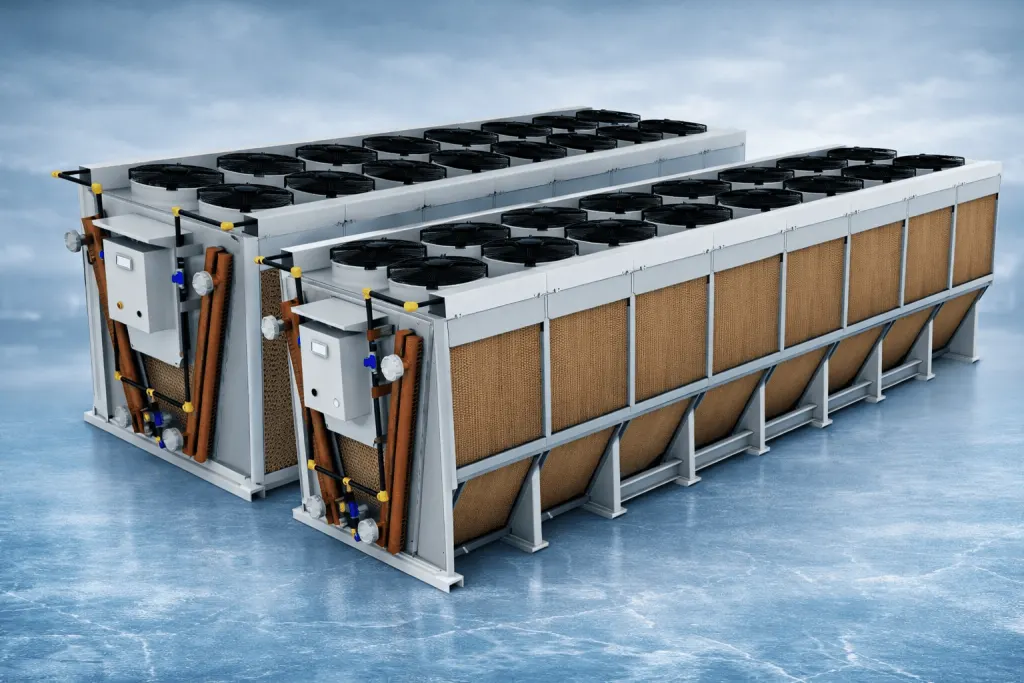
Intercoolers, aftercoolers and oil circuits of CNG, biomethane, hydrogen, nitrogen or process gas compressors need a constant supply of cooling water. There are two main ways to provide it: a closed-circuit dry cooler or a chiller. The right choice depends on the water temperature the compressor requires and the summer temperature at the site.
When is a dry cooler enough?
A dry cooler cools water with ambient air and can bring it down to a few degrees above ambient temperature. If the cooling water temperature allowed by the compressor manufacturer stays above this value even in summer, a dry cooler is the most economical solution.
- No water consumption and no evaporation loss as with a tower.
- Being a closed circuit, there is no scaling or fouling in the heat exchangers.
- With a glycol circuit there is no freezing risk in winter.
- Adiabatic pre-cooling can be added for hot days.
When is a chiller needed?
If the gas outlet temperature must be close to or below ambient temperature, for example for cooling filling gas, gas drying or hydrogen dispenser pre-cooling, a chiller is essential. A chiller provides constant water temperature whatever the outdoor air.
Hybrid solution
In many plants the most efficient approach is to separate two circuits: the compressor jacket and oil cooler are fed by a dry cooler, the aftercooler and exchangers needing low temperature by a chiller. The chiller then runs only for the load that truly needs low temperature and its capacity is smaller. In winter the dry cooler can also cover part of the chiller load through free cooling.
Typical selection by application
- CNG compressor: Dry cooler for the jacket, chiller for the aftercooler and filling gas (CNG compressor cooling).
- Biomethane plant: Chiller for gas drying, dry cooler for compressors (biomethane cooling).
- Hydrogen station: Dry cooler or chiller for the compressor, low-temperature refrigeration unit for dispenser pre-cooling (hydrogen compressor cooling).
- Virtual pipeline mother station: Hybrid system for continuous high-flow operation (virtual pipeline cooling).
Frequently asked questions
Does it make sense to replace an existing open tower with a dry cooler?
Yes, if you have scaling, water consumption and maintenance problems and the water temperature required by the compressor is suitable. Before replacement, the water temperature reachable in summer conditions must be calculated.
Can a dry cooler and a chiller work in the same circuit?
Yes. The dry cooler can pre-cool the water before the chiller to reduce chiller load, and run on its own in winter.
What information is needed for selection?
Compressor type and number, heat rejection values, allowed water inlet temperature, gas outlet temperature target and the summer temperature at the site are enough.
For the heat exchanger side, see our gas heat exchanger cooling article.
For other applications in the energy and gas sector, see our energy and gas sector cooling page.
Let us assess your plant together. Send your compressor and gas data by WhatsApp or e-mail; our engineers will calculate the cooling demand and propose a suitable system in writing.